
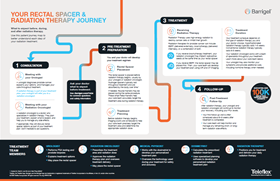
Consultation

Meeting with your Urologist
A urologist diagnoses prostate cancer, explains your options, and manages your care throughout treatment.
If radiation therapy is part of your treatment plan, your urologist will refer you to a radiation oncologist.

Meeting with your Radiation Oncologist
A radiation oncologist is a doctor who specializes in radiation therapy. They plan your treatment, explain what to expect, and help you to manage any side effects.
If appropriate, they will discuss rectal spacer options as part of your treatment plan. Don't hesitate to ask questions.
Return to topAsk your doctor what to expect before treatment. See Barrigel.com/FAQs for common questions and safety information.
Pre-Treatment Preparation
You and your doctor will develop your treatment regimen
Rectal Spacer Placement
The rectal spacer is placed before radiation therapy begins, usually by your urologist or radiation oncologist. Hydrogel spacers typically last throughout treatment and are absorbed by the body over time.1
If needed, fiducial markers may be placed during the same procedure. These small metal markers help your care team accurately target the treatment area during radiation therapy.
Treatment Planning
Before radiation therapy begins, imaging scans are scheduled to help your care team precisely target the treatment area and determine the appropriate radiation dose.
Return to topTreatment

Receiving Radiation Therapy
Radiation Therapy uses high-energy radiation to destroy cancer cells or inhibit their growth.
Radiation therapies for prostate cancer can include EBRT (delivered externally), brachytherapy (delivered internally), or a combination of both.
If you receive brachytherapy treatment, your radiation oncologist may implant radioactive seeds at the same time as your rectal spacer.
If you receive EBRT, the rectal spacer may be placed first. Then, your care team will develop your treatment plan using MR and CT imaging.

Treatment Duration
Your treatment schedule depends on the type of radiation therapy you and your doctor choose.
Your radiation oncologist works with a team of specialists throughout your treatment. Learn more about your care team below.
Your urologist may also monitor your symptoms and provide additional care, including hormone therapy when needed.
Return to topFollow-Up

Post-Treatment Follow-Up
After radiation therapy, your urologist and radiation oncologist will continue to monitor your recovery, including your PSA levels.
›Your first follow-up visit is often scheduled about 6–8 weeks after treatment is completed.
›Your care team will help monitor and manage any remaining short- or long-term radiation side effects.
Return to top
 UROLOGIST
●Performs PSA testing and prostate biopsies
●Explains treatment options
●May place the rectal spacer
 RADIATION ONCOLOGIST
●Prescribes the treatment area and radiation dose
●Approves the radiation therapy plan and oversees treatment delivery
●May place the rectal spacer
 MEDICAL PHYSICIST
●Works with the dosimetrist to develop your personalized treatment plan
●Oversees the technology used during your treatment for safety and accuracy
 DOSIMETRIST
●Calculates the prescribed radiation treatment
●Uses specialized planning software to develop your personalized radiation treatment plan
RADIATION THERAPIST
●Positions you for treatment and delivers your daily radiation therapy